Monday, 4 April 2016

Dynamic Viscosity of Spacetime

Okay, so, time for a new idea! :-) A few days ago, while pondering over a biological experiment, a friend of mine mentioned fluid dynamics, particularly viscosity. For those of you are are not familiar with the term, viscosity is the property of a fluid to resist motion between its layers. It can be understood bluntly to be like the friction between two surfaces. Interesting property indeed!

Now flashback to about four months ago, where I was trying to figure out how much force will a body need to be applied to, in order to reach a certain acceleration, in a relativistic world. The formula I could derive was very different of what we know of through the Newtonian laws of Physics. The interesting thing, though, was the fact that force required in order to reach a certain acceleration in a relativistic world is always greater than that required in a classical world.

Thus, this difference in magnitudes of forces in relativistic world and classical world can be seen as a resistance that a body has to overcome in the relativistic world in order to reach a certain acceleration, while no such resistance is faced if we go by the Newtonian laws. Moreover, this resistance increases as our speed increases.


Here, γ = 1/sqrt(1-v2/c2) and is called the Lorentz factor, m is the absolute mass or rest mass of the body, a is the constant acceleration it possesses, v is its instantaneous speed, subscript c refers to classical and subscript R refers to relativistic, P refers to momentum and F refers to force.

This gave me an idea. I had read that research is going on in the area where they consider spacetime to be a superfluid, i.e. a fluid without viscosity. What if spacetime is a viscous fluid, because if it is, then I can easily relate Stoke's Law of Fluid Mechanics to my drag force! But, wait a minute, what is Stoke's Law?

Stoke's Law in fluid mechanics gives the formula for the force that will be experienced by a spherical object of radius R when it tries to move forward in a viscous liquid with a speed v. They call this resistive force as drag force. So, my idea here is to equate this drag force with the difference between relativistic force and classical force in order to find µ , i.e. the dynamic viscosity of spacetime, or in order to make you understand, the measure of stiffness of spacetime.

Here, E=mc^2. We all know where that came from! ;-) So, if my calculations are right (believe me they are, I rechecked like 20 times), then that is the formula for the dynamic viscosity of spacetime. But what is the significance of this dynamic viscosity? 

Well, it is not difficult to imagine that if the density of the fluid increases, its viscosity or stiffness will increase. Let us go the other way round, if viscosity if increasing, and no ther factor is affected, then density of the fluid must be increasing. Hence, as a body moves with faster velocity, viscosity of spacetime around it increases and so does the density. Spacetime becoming denser, if you visualize, is similar to warping of spacetime around the body, which is rightfully predicted by General Relativity. So, the theory explains why the spacetime is getting warped around a moving body! 

You would say that its relativistic mass is increasing as its speed increases, so the warping. But tell me this then, why is the mass increasing in the first place? I think that due to the movement of the body, viscosity of spacetime around it increases, resulting in denser spacetime, which indirectly means warping of spacetime around the body, which results in its increased gravitational effect! Well, something to think about! :-)

Saturday, 22 August 2015

Report on Mathematical Explanations of the Spring Theory

The theory proposes that the spacetime fabric has spring-like characteristics and examines the outcomes of the assumption. The spacetime fabric’s spring-like nature results in it executing Simple Harmonic Motion (SHM) just like a compressed spring. Mathematically,

Symbol
For SHM by spacetime fabric
For SHM by particle attached to the spring
x
Present radius of observable universe
Position of particle attached to spring
A
Maximum radius that the observable universe can attain
Amplitude or Maximum displacement of the particle about mean point
ω
2*π*f (where f=frequency)
t
Age of the observable universe
The time that has passed since start of the SHM
φ
Phase difference
Phase difference


·        Outcomes-
  • Big Bang and the fate of the Universe- The hypothesis explains how initially the entire universe was compressed into a small particle (singularity) just like a compressed spring. After the bang, the space time fabric expanded with increasing acceleration in all directions and it still is expanding. Once the natural length of the fabric is reached, it will still expand but with decreasing acceleration, eventually coming to a stop with radius as A (defined above) same as the maximum displacement of a particle at the end of a spring. From there, the fabric will begin deceleration finally converging back to a singularity creating the same conditions as were before the Big Bang.
  • Dark Energy- Just like the potential energy stored in a spring, dark energy might be nothing else but just the potential energy stored in the spacetime fabric due to its spring-like nature.
  • On solving the given equations,
  1. ω = 2.16 x 10^(-78) rad/s
  2. A = 5.36 x 10^(86) m = 5.65 x 10^(70) light years
  3. T = 9.29 x 10^(70) years
Results-

If the theory holds true,
  • The maximum radius of the observable universe is 5.65 x 10^(70) light years.
  • Total life of the observable universe is 9.29 x 10^(70) years.

Sunday, 26 July 2015

The Spring Theory- Can it be this simple?

It often happens in science that we tend to justify certain phenomena and find logic through complex justifications even though the actual reasoning is quite simple! For many years now, dark energy has been a mystery in the scientific world, because of its repulsive powers. While investigating the mystery of dark energy, I have come up with a theory called the Spring Theory, in which I try to simplify this concept of dark energy and provide a theoretical explanation for it.

According to this theory of mine, the spacetime fabric has spring-like properties. Then, before the Big Bang, it was all compressed into one small particle just like a compressed spring. Now, as soon as the particle “banged” the fabric, just like a compressed spring, started accelerating. If the motion of a spring is observed, it is seen that a particle attached to a spring accelerates till the spring has reached its natural length and after that, the particle begins to decelerate. Similarly, the expansion of fabric is accelerating at present, meaning to say, that the fabric has still not reached its natural length. Thus, according to the Spring Theory, since we are comparing the spacetime fabric to a spring, then Dark Energy is nothing but the potential energy of the spring, something very less mysterious than the Dark Energy itself.

The theory also proposes, though indirectly, the fact that the Universe will have a center. This is contrary to popular belief. But, what should we understood is that the Universe is said to have no center just because every particle is moving away from every other particle. Meaning to say, if you choose any point in this Universe, you will observe that all the other points are moving away from it. Hence, every point in the universe acts as a center of expansion. But, if we proceed by the explanation of expansion that my theory proposes, the same fact is observed.

Now let us talk about what the theory will imply. The theory implies that the universe is undergoing accelerated expansion till the time the spacetime fabric reaches its natural length, after which it will undergo decelerated expansion finally coming to rest with a certain maximum radius. Then the universe will begin to contract, just like a stretched spring, and will soon end up in a small particle, from where it started. Another major phenomena explained by the theory is the drifting away of Earth from Sun, the Moon from Earth, and so on. If the spacetime fabric is expanding, the curvature made by celestial bodies will increase with time, hence decreasing their gravitational pull. This will directly result in the decrease in gravitational pull of all celestial bodies, the Sun, the Moon, the Earth, etc. and hence they will gradually drift away from each other.


The Spring Theory is just a hypothesis which I formulated to simplify the concept of Dark Energy, and is nowhere near proven. But, it does give us a different perspective towards explaining the mysterious phenomenon of this ever-so-mysterious Universe. But, what does this theory suggest about the even-more-mysterious black holes? We will see in the next post!!

Thursday, 16 April 2015

The New Fields- Is the Higgs Field the Only Existing Field?

In the last article, I talked about how the existence of some unknown particles can facilitate the explanation of the certain phenomena and anomalies in the field of Science. But, before talking about them, let me tell you something about the discovery which has inspired this theory of mine: the Higgs Boson.

In simple, non-technical words, Higgs Boson is the particle that makes up the Higgs Field. According to Peter Higgs, who proposed the Higgs Field, any particle will gain mass when it interacts which the Higgs Field. A particle that interacts more is heavier, and a particle which interacts less is lighter. Particles which do not interact with the Higgs Field are said to be massless, eg: photons. Thus, Higgs Boson, also termed as the God particle, is said to give mass to elements. This video by TED-Ed explains in a rather interesting way the concept of Higgs Boson. Do take a look!


I think all interactions take place in the same way. What I mean to say is that, just like interaction with the Higgs Field gives mass to a particle, similarly, according to my theory, interaction with the Space Field will give a particle space (dimensions) while the Time Field will make the particle perceive time! In short, in this theory, I propose the existence of a Time Field and a Space Field.

In his General Theory of Relativity, Einstein showed how time is relative. For some bodies, time moves faster, and for other, it moves slowly. The Interstellar fans will know what I mean to say! Now, why does that happen? My theory can propose an answer. More a particle interacts with the Higgs Field, the heavier it is. Similarly, more a particle interacts with the field of time, the faster time moves for that particle. Meaning to say, if A and B are two particles, and A undergoes greater interaction with Time Field as compared to B, then time for A will move faster with respect to B. 

Similarly, more a particle interacts with Space Field, the bigger it is! Though, we must remember here, that this applies to microparticles only, the fundamental particles which make up our world. But now, you must be thinking, that okay, so these fields do exist, then what?

The interaction of these fields itself create the properties of matter. When the Space Field, the Time Field and the Higgs Field interact, then the matter gets its fundamental properties: it acquires mass (due to interaction with Higgs field), has some space (due to interaction with the space field) and perceives time (due to interaction with Time Field).  

So, we know that if a particle does not interact with Higgs Field, then it is massless. But what if a particle does not react with the Time Field? YES, then the particle will not perceive time! Photons travel at the speed of light, and theoretically at that speed, time slows down to such an extent that time theoretically STOPS for photons. Photon experience no time. Hence, this may very well be an evidence that photons do not interact with the time field.  

A particle travelling at the speed of light when enters the higgs field and interacts, some of its kinetic energy gets converted to its mass, and so, the particle no longer moves with the speed of light, and so, it starts perceiving time. Thus, for a particle to interact with the field of time, it should definitely lose its kinetic energy if it is travelling at the speed of light. Hence, we can conclude, that certain amount of energy will be required to make time speed faster or slower for a body! This is the concept which I think can eventually lead to making a Time Machine, my ultimate dream!

Lots of stuff to think about in this post, let us leave the rest for the next month's post! After understanding this concept, you might want to know how this theory is going to change our perception about the universe we know about. Well, keep your curiosity levels high, and wait for the next post!

Thursday, 19 February 2015

The CAUSE of Big Bang- WHY it all started?


Yeah, I know, I am breaking the rule here. I did say one post every month, but I will be a bit busy in March due to my exams, and also that I am too enthusiastic to share this theory of mine with you all, so here is the second post of this month! As usual, I ended my last post with a question: We all know what happened after the Big Bang, but no one has ever tried to explain WHY did the Big Bang happen? So, I aim to answer the question in this post. But before I start, let us get some basics clear.


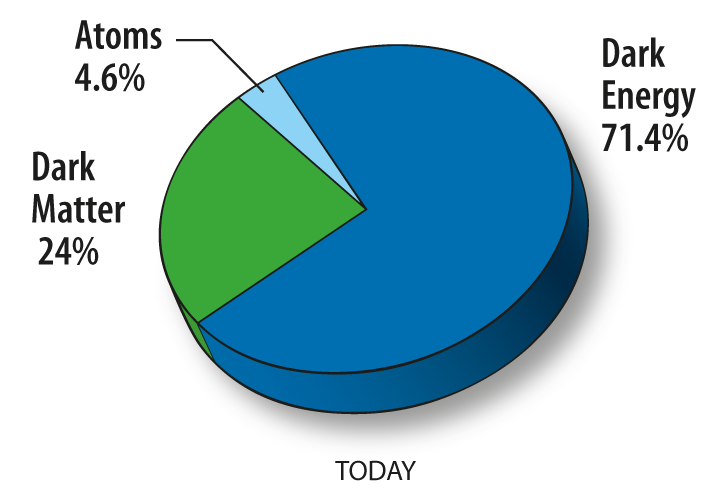
Ordinary form of matter, like table, chair, your computer, you, the stars, the planets, etc. is an absolute minority in what comprises this vast universe. The universe is said to be composed majorly of some mysterious matter and energy, rightly called the dark matter and dark energy. 

Source: http://wmap.gsfc.nasa.gov/media/121236/121236_NewPieCharts720.png

A brief introduction: Scientists observed that galaxies move with way more speed than that should be possible due to their present mass. Thus, they concluded that there must be some "missing mass" which they are not able to see or detect, but it has its gravitational influence! They called this "missing mass" dark matter. On the other hand, earlier scientists believed that the universe must be contracting due to the gravitational attractions of massive bodies. But, the Hubble Telescope provided information that contradicted it. The information (not going into what the information exactly was) proved that the universe was indeed expanding! Now scientists were in a fix! Thus, they concluded, yet again, that there must be some mysterious energy that is repelling bodies and is enabling the universe to expand. With no clue of what it is, they called it dark energy!   


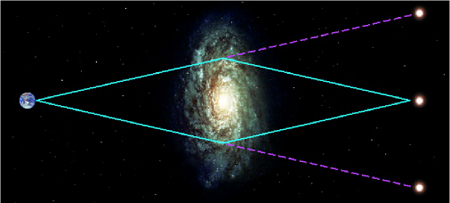
Now, dark matter and dark energy are entirely invisible. They do not interact with any form of known matter, though the gravitational effect of dark matter is felt and "gravitational lensing" is an example of its visible effects. "Gravitational lensing" is nothing but bending of light due to gravitational effect of dark matter. The first picture shows what causes gravitational lensing and the second picture shows its effect. The arcs you see are because of gravitational lensing.Dark matter is attractive in nature and dark energy is repulsive, and that is all that we know about them. One more thing, there are millions of dark matter particles going past us, through us, through the walls, through the earth, every second, and we just don't feel them, again because they do not interact with anything!
Having talked about dark energy and dark matter and having substantial knowledge about them, I could still not figure out what they actually are! And then, an idea struck me. And then, as I developed that idea, and I found a way to tell about the cause of Big Bang while explaining the known properties of dark matter and dark energy at the same time.

Dark Energy and Dark Matter, I think, are multi-dimensional matter, i.e. like we humans are 3 dimensional beings, dark energy and dark matter may be nothing else but matter which is more than 3 dimensional and hence it cannot be perceived easily by us, due to the different kind of energy that it possesses, though its effect can be felt. 

I hypothesize that before the BIG BANG, a particle existed which itself was made of multiple dimensions. Its constituents were dark matter and dark energy, i.e. multi-dimensional form of matter. To simplify, like we humans being 3 dimensional can be considered to be made of 3 dimensional particles, which themselves are made of 2 dimensional particles and which are made of 1 dimensional particles, similarly, that starting particle, which was multi-dimensional, was made of particles of different dimensions which we now know as dark energy and dark matter.  

Source: http://prancer.physics.louisville.edu/
The picture evidently shows how dark energy has evolved at a greater rate than dark matter during the evolution of the universe. Similarly, inside that starting particle, initially, dark matter was in majority and hence it held the starting particle firmly. But, later, as the dark energy began evolving in greater amounts, it started to counter the force by dark matter and tried to expand the particle. At an instant, dark energy had evolved to such great extent that it could have expanded the particle, but the dark matter still held the particle firmly. And hence, there occurred a BANG, where the starting multi-dimensional particle disintegrated into many other particles of simpler but varied dimensions, i.e. 1D, 2D, 3D, 4D, etc. among which 3D constitutes only a small part of the universe. Thus, except us 3D beings, there exist various forms of matter in varying dimensions. Due to their higher dimensions, they cannot be perceived by us but surely exert their share of gravitational force. This itself we call dark matter and dark energy!

Also, remembering the conclusion I had made in my first post: An object experiences a force when its energy interacts with that of the agent. Dark energy and dark matter, being multi-dimensional, have energy which cannot interact with that of light, due to the difference in the cause of their energies. Hence, due to no interaction, no reflection of light takes place when light passes through them, and hence, dark energy and dark matter are invisible, though, bending of light can occur due to the gravitational effect of this form of matter. 

The String Theory talks about how our universe may not be three-dimensional, i.e. how we see it to be, but it indeed may be 10-Dimensional hyperspace, while the M-Theory talks about 11-Dimensional hyperspace. This proposal is a result of the mathematical conclusions derived in the theories. While speculating about our origin and its cause, this theory faintly approves of the idea of multi-dimensional hyperspace. Though the String Theory is yet to be proven, it indeed is extremely intriguing and creative! 

It all fits, doesn't it? But again, this is just a hypothesis based on an idea that struck me and may very well be far from reality! Dark Matter and Dark Energy may not even exist! It is even a possibility that they are composed of a new fundamental particle which is still missing from our Standard Model. What can that be? A special particle, with what properties? We will see in my next post!