The theory proposes that the spacetime
fabric has spring-like characteristics and examines the outcomes of the
assumption. The spacetime fabric’s spring-like
nature results in it executing Simple Harmonic Motion (SHM) just like a
compressed spring. Mathematically,
Symbol
|
For
SHM by spacetime fabric
|
For
SHM by particle attached to the spring
|
x
|
Present radius of observable universe
|
Position of particle attached to spring
|
A
|
Maximum radius that the observable universe can attain
|
Amplitude or Maximum displacement of the particle about mean point
|
ω
|
2*π*f (where f=frequency)
|
2*π*f (where f=frequency)
|
t
|
Age of the observable universe
|
The time that has passed since start of the SHM
|
φ
|
Phase difference
|
Phase difference
|

·
Outcomes-
- Big Bang and the fate of the Universe- The hypothesis explains how initially the entire universe was compressed into a small particle (singularity) just like a compressed spring. After the bang, the space time fabric expanded with increasing acceleration in all directions and it still is expanding. Once the natural length of the fabric is reached, it will still expand but with decreasing acceleration, eventually coming to a stop with radius as A (defined above) same as the maximum displacement of a particle at the end of a spring. From there, the fabric will begin deceleration finally converging back to a singularity creating the same conditions as were before the Big Bang.
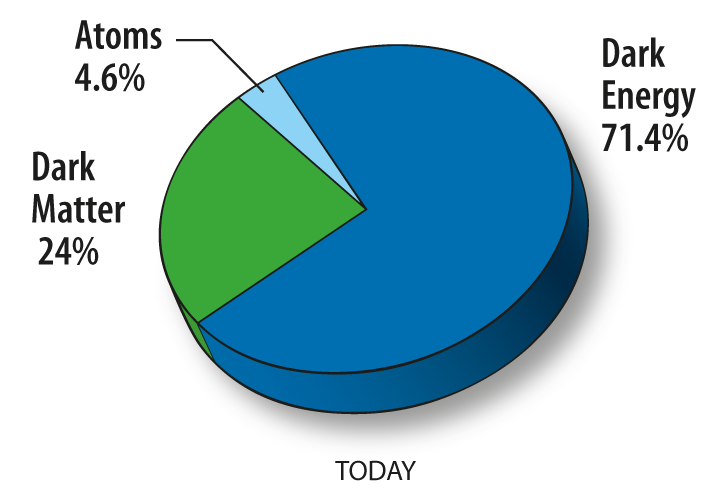
- Dark Energy- Just like the potential energy stored in a spring, dark energy might be nothing else but just the potential energy stored in the spacetime fabric due to its spring-like nature.
- On solving the given equations,
- ω = 2.16 x 10^(-78) rad/s
- A = 5.36 x 10^(86) m = 5.65 x 10^(70) light years
- T = 9.29 x 10^(70) years
Results-
If the theory holds true,
- The maximum radius of the observable universe is 5.65 x 10^(70) light years.
- Total life of the observable universe is 9.29 x 10^(70) years.