Thursday, 8 June 2017

Mathematics: God's gift to physicists!

It has taken me some time, but I have realized now what most physicists do at some point in their life: you can not possibly become a functioning physicist without having a strong hold on mathematics. Yes, experimental and theoretical alike! One might think that understanding the laws of physics must serve one well, but while that is the necessary condition it surely isn't a sufficient one (Pun #1). While understanding physics well itself requires a lot of mathematics, researching in physics is a whole another ball game. I say this because when you are involved in researching you attempt to expand the boundaries of our knowledge, and that, at least for a theorist, requires extreme mathematical rigor. Why? Because mathematics is the only tool known to mankind that one can use to justify one's hypothesis. You make assumptions based on the facts you already know (or believe) are true and based on those assumptions you derive the mathematical form of your idea. And it doesn't end there, your theory isn't proved until it can be proven experimentally, ask Peter Higgs! I had started this post to express how important mathematics is for a physicist, and have drifted to telling you about the plight of a theorist. What a subtle distraction indeed.

While physics answers the 'why' behind a physical phenomenon, mathematics answers the 'why' behind the formulation involved in answering the former 'why'. For example, while you might know about how quantum mechanics involves Hilbert spaces and Dirac notation and is able to precisely explain the quantum world, functional analysis tells you why use Hilbert spaces, among all others, in the first place. Mathematics is like a tool box a physicist must have, and knowing more doesn't hurt because you never know what tool may be required to solve what problem. When I was in secondary school, I always felt that matrices were a lame topic. You arrange numbers in a definite form to ease calculations. Only in college did I understand the vastness of the field. Think of it, matrix algebra, linear algebra to be general, is one of the most important topics for a physicist as all the basic concepts and subjects one learns involves these bad boys. 

And complex numbers, don't get me started on complex numbers. I can say this without even an iota of doubt that they are the most beautiful part of mathematics I have yet encountered (Pun #2). If you think about it, it is a very simple idea: what if we took the square root of -1? And there you have it, i, a letter that changed how people looked at the world. Moving from imaginary to some real stuff, no matter how much we get accused of being day dreamers, physicists work towards explaining things that are real. While we might get rigorous with complex numbers, at the end of the day, real numbers are what we return to. This itself makes it very important for a physicist to understand real numbers, and real analysis sure helps a lot in it.

I know what you are thinking, three paragraphs in and I haven't mentioned calculus! Well, do I need to? Calculus to me feels like a mathematicians' version of a theory of everything. Before you say it, I know calculus can not be used everywhere, but I say this because of the immense applicability of the subject. Well, I am sure Leibniz and Newton will be proud. 

Sometimes people claim that physics is just applied mathematics. While this may sound tempting to mathematicians, I will have to side with the physicists here. I know that a mathematician can very well derive the same laws that a physicist did and in probably a more elegant manner, but a mathematician might not be able to appreciate the meaning behind that law like a physicist can. The difference in what they appreciate is what differentiates between the two most amazing people in the word: the mathematician and the physicist.

Sunday, 12 February 2017

Quantum Mechanics- First Impressions!

You know when you've heard about something being extremely mysterious, mind-boggling and makes people's world turn round, but you've never had the chance of getting introduced to it? That is what Quantum Mechanics was for me, until this January. I had read people say that if you do understand Quantum Mechanics, you don't know it well enough. Such a claim makes a curious mind anxious and excited at the same time. So, without anymore build up, let me tell you about my first impression of Quantum Mechanics after one month of study.


When one is introduced to QM, it does not take one much long to realize that QM is not a theory that illustrates human incompetency during experiments, but actually, one that sheds light on the 'spooky' way in which nature works at the smallest level, namely, the quantum level. What attracts some and repels others is the fact that initially, QM challenges intuition. But if you are exposed to it for long enough and in the right way, it redefines intuition and the way you see the world. Classically, we have been taught about discrete systems with definite states and properties. So, classical mechanics talks about certainty and some might stretch the laws to even talk about determinacy. Then comes QM which talks about probabilities and uncertainties. Not only that, the Heisenberg's uncertainty principle states that uncertainty is embedded in the working of the universe. In my opinion, this leap from classical to quantum in one's intuition is the difficult part when it comes to mastering QM. 

QM owes its success to its mathematical formulation. We can mathematically calculate the outcome of an experiment without even conducting it. And when we do end up conducting the experiment, the theoretical and the experimental outcomes are in complete agreement. Whenever this happens, it lightens up the day of a physicist. Knowing this, in my opinion, one needs to realize that the best way to understand QM is to approach it mathematically and master the mathematics that makes up the theory. Once you have accomplished that mighty task, you can begin with developing the intuition for QM such that the much talked about 'spooky' action now becomes 'expected'. 


At present, I am only in the beginning stages of exploring this vast field. I started by learning about vector spaces, Dirac notation including the ket and the bra spaces, operators and their eigenvectors and eigenvalues, and their action on kets resulting in quantum states. So, you see, I really haven't done much. But the much I have done makes me excited about what is going to come and what more can be done using QM. I am curious to know how the basic principles will give rise to mysterious concepts of quantum entanglement, etc. and how and where I will be able to use my knowledge in this field.


I read about Einstein's trouble with QM and justifiably so, given the fact that QM and General Relativity don't go hand-in-hand. This is a major problem in Physics, a problem I am already interested in. It does create a sense of zeal when trying to connect a theory that works at the largest scale to one that works at the smallest. This reminds me, I am also taking a course in Theory of Relativity this semester which aims to make me proficient in Special Relativity and its consequences, and also introduce me to the formulation and aspects of General Relativity. But, talking about that is a whole other post!

Sunday, 13 November 2016

Hi there!

Hi. My name is Ish Mohan Gupta. I am 19 years old and currently pursue my Masters in Physics at BITS Pilani KK Birla Goa Campus, India. My current interests lead to me desire a career as a Theoretical Physicist, in service to the field which in my opinion is the most awe-inspiring and rewarding.

As a 10 year-old, I was fascinated with planets and stars, who isn't, but to become a physicist was never an ambition. My aspirations varied from being an astronaut to a cricketer. But, later in life, by the time I was 15 years old I began questioning things I didn't understand. Well, to be honest, I even questioned the validity of things I did understand. In short, I didn't take things to be for granted. I wanted to confirm each phenomenon that interested me by myself.

In the way, I got introduced to the genius of Albert Einstein who somehow made me believe, even if that wasn't his intention, that if understanding the world is not simple enough, then it is just not understood well enough. So, whenever I read about a theory and understood all that I could given my knowledge as a mid-teen, I would question its complexity while also admiring the inherent beauty it had.  But, some of the unexplained phenomena and conjectures around them made me ask myself that why does something have to be this difficult to explain. which lead me to formulate my own theories.

If you view all the posts in this blog, from the earliest ones to the latest ones, you might appreciate how I have grown as a Physicist (if I am at all allowed to call myself that). While the earliest ones seem extremely childish and far from being scientific, the latest ones I am proud of. It took me time to accept the role of mathematical rigor in Physics and as you will observe that somewhere down the line, I have indulged in that too. This journey, though of merely 3-4 years now has made me embrace the bond Physics and Mathematics share which has largely contributed to my frequent adventures in Mathematics.

This blog does not only contain my theories, but also my views on everyday Physics, which includes current advancements, opinions about different theories, my experience studying different subjects in Physics as I complete the remaining years of my education, and anything else worth sharing. I might also talk about Mathematics, though seldom, as I attempt to explore the seemingly abstract field.

Finally, I often ponder over what I want in life? Is it to win a Nobel Prize? Is it to become a genius? I think genius is nature-given, one is born with it, it is not really in our hands. What is in our hands is mastery. Hence, I aim to gain mastery over my field, to know anything and everything that the field has to offer. While that might seem vague, abstract and unattainable, you must remind yourself that I am a Physicist, what else did you expect? ;-)

Monday, 4 April 2016

Dynamic Viscosity of Spacetime

Okay, so, time for a new idea! :-) A few days ago, while pondering over a biological experiment, a friend of mine mentioned fluid dynamics, particularly viscosity. For those of you are are not familiar with the term, viscosity is the property of a fluid to resist motion between its layers. It can be understood bluntly to be like the friction between two surfaces. Interesting property indeed!

Now flashback to about four months ago, where I was trying to figure out how much force will a body need to be applied to, in order to reach a certain acceleration, in a relativistic world. The formula I could derive was very different of what we know of through the Newtonian laws of Physics. The interesting thing, though, was the fact that force required in order to reach a certain acceleration in a relativistic world is always greater than that required in a classical world.

Thus, this difference in magnitudes of forces in relativistic world and classical world can be seen as a resistance that a body has to overcome in the relativistic world in order to reach a certain acceleration, while no such resistance is faced if we go by the Newtonian laws. Moreover, this resistance increases as our speed increases.


Here, γ = 1/sqrt(1-v2/c2) and is called the Lorentz factor, m is the absolute mass or rest mass of the body, a is the constant acceleration it possesses, v is its instantaneous speed, subscript c refers to classical and subscript R refers to relativistic, P refers to momentum and F refers to force.

This gave me an idea. I had read that research is going on in the area where they consider spacetime to be a superfluid, i.e. a fluid without viscosity. What if spacetime is a viscous fluid, because if it is, then I can easily relate Stoke's Law of Fluid Mechanics to my drag force! But, wait a minute, what is Stoke's Law?

Stoke's Law in fluid mechanics gives the formula for the force that will be experienced by a spherical object of radius R when it tries to move forward in a viscous liquid with a speed v. They call this resistive force as drag force. So, my idea here is to equate this drag force with the difference between relativistic force and classical force in order to find µ , i.e. the dynamic viscosity of spacetime, or in order to make you understand, the measure of stiffness of spacetime.

Here, E=mc^2. We all know where that came from! ;-) So, if my calculations are right (believe me they are, I rechecked like 20 times), then that is the formula for the dynamic viscosity of spacetime. But what is the significance of this dynamic viscosity? 

Well, it is not difficult to imagine that if the density of the fluid increases, its viscosity or stiffness will increase. Let us go the other way round, if viscosity if increasing, and no ther factor is affected, then density of the fluid must be increasing. Hence, as a body moves with faster velocity, viscosity of spacetime around it increases and so does the density. Spacetime becoming denser, if you visualize, is similar to warping of spacetime around the body, which is rightfully predicted by General Relativity. So, the theory explains why the spacetime is getting warped around a moving body! 

You would say that its relativistic mass is increasing as its speed increases, so the warping. But tell me this then, why is the mass increasing in the first place? I think that due to the movement of the body, viscosity of spacetime around it increases, resulting in denser spacetime, which indirectly means warping of spacetime around the body, which results in its increased gravitational effect! Well, something to think about! :-)

Saturday, 22 August 2015

Report on Mathematical Explanations of the Spring Theory

The theory proposes that the spacetime fabric has spring-like characteristics and examines the outcomes of the assumption. The spacetime fabric’s spring-like nature results in it executing Simple Harmonic Motion (SHM) just like a compressed spring. Mathematically,

Symbol
For SHM by spacetime fabric
For SHM by particle attached to the spring
x
Present radius of observable universe
Position of particle attached to spring
A
Maximum radius that the observable universe can attain
Amplitude or Maximum displacement of the particle about mean point
ω
2*π*f (where f=frequency)
t
Age of the observable universe
The time that has passed since start of the SHM
φ
Phase difference
Phase difference


·        Outcomes-
  • Big Bang and the fate of the Universe- The hypothesis explains how initially the entire universe was compressed into a small particle (singularity) just like a compressed spring. After the bang, the space time fabric expanded with increasing acceleration in all directions and it still is expanding. Once the natural length of the fabric is reached, it will still expand but with decreasing acceleration, eventually coming to a stop with radius as A (defined above) same as the maximum displacement of a particle at the end of a spring. From there, the fabric will begin deceleration finally converging back to a singularity creating the same conditions as were before the Big Bang.
  • Dark Energy- Just like the potential energy stored in a spring, dark energy might be nothing else but just the potential energy stored in the spacetime fabric due to its spring-like nature.
  • On solving the given equations,
  1. ω = 2.16 x 10^(-78) rad/s
  2. A = 5.36 x 10^(86) m = 5.65 x 10^(70) light years
  3. T = 9.29 x 10^(70) years
Results-

If the theory holds true,
  • The maximum radius of the observable universe is 5.65 x 10^(70) light years.
  • Total life of the observable universe is 9.29 x 10^(70) years.

Sunday, 26 July 2015

The Spring Theory- Can it be this simple?

It often happens in science that we tend to justify certain phenomena and find logic through complex justifications even though the actual reasoning is quite simple! For many years now, dark energy has been a mystery in the scientific world, because of its repulsive powers. While investigating the mystery of dark energy, I have come up with a theory called the Spring Theory, in which I try to simplify this concept of dark energy and provide a theoretical explanation for it.

According to this theory of mine, the spacetime fabric has spring-like properties. Then, before the Big Bang, it was all compressed into one small particle just like a compressed spring. Now, as soon as the particle “banged” the fabric, just like a compressed spring, started accelerating. If the motion of a spring is observed, it is seen that a particle attached to a spring accelerates till the spring has reached its natural length and after that, the particle begins to decelerate. Similarly, the expansion of fabric is accelerating at present, meaning to say, that the fabric has still not reached its natural length. Thus, according to the Spring Theory, since we are comparing the spacetime fabric to a spring, then Dark Energy is nothing but the potential energy of the spring, something very less mysterious than the Dark Energy itself.

The theory also proposes, though indirectly, the fact that the Universe will have a center. This is contrary to popular belief. But, what should we understood is that the Universe is said to have no center just because every particle is moving away from every other particle. Meaning to say, if you choose any point in this Universe, you will observe that all the other points are moving away from it. Hence, every point in the universe acts as a center of expansion. But, if we proceed by the explanation of expansion that my theory proposes, the same fact is observed.

Now let us talk about what the theory will imply. The theory implies that the universe is undergoing accelerated expansion till the time the spacetime fabric reaches its natural length, after which it will undergo decelerated expansion finally coming to rest with a certain maximum radius. Then the universe will begin to contract, just like a stretched spring, and will soon end up in a small particle, from where it started. Another major phenomena explained by the theory is the drifting away of Earth from Sun, the Moon from Earth, and so on. If the spacetime fabric is expanding, the curvature made by celestial bodies will increase with time, hence decreasing their gravitational pull. This will directly result in the decrease in gravitational pull of all celestial bodies, the Sun, the Moon, the Earth, etc. and hence they will gradually drift away from each other.


The Spring Theory is just a hypothesis which I formulated to simplify the concept of Dark Energy, and is nowhere near proven. But, it does give us a different perspective towards explaining the mysterious phenomenon of this ever-so-mysterious Universe. But, what does this theory suggest about the even-more-mysterious black holes? We will see in the next post!!

Thursday, 16 April 2015

The New Fields- Is the Higgs Field the Only Existing Field?

In the last article, I talked about how the existence of some unknown particles can facilitate the explanation of the certain phenomena and anomalies in the field of Science. But, before talking about them, let me tell you something about the discovery which has inspired this theory of mine: the Higgs Boson.

In simple, non-technical words, Higgs Boson is the particle that makes up the Higgs Field. According to Peter Higgs, who proposed the Higgs Field, any particle will gain mass when it interacts which the Higgs Field. A particle that interacts more is heavier, and a particle which interacts less is lighter. Particles which do not interact with the Higgs Field are said to be massless, eg: photons. Thus, Higgs Boson, also termed as the God particle, is said to give mass to elements. This video by TED-Ed explains in a rather interesting way the concept of Higgs Boson. Do take a look!


I think all interactions take place in the same way. What I mean to say is that, just like interaction with the Higgs Field gives mass to a particle, similarly, according to my theory, interaction with the Space Field will give a particle space (dimensions) while the Time Field will make the particle perceive time! In short, in this theory, I propose the existence of a Time Field and a Space Field.

In his General Theory of Relativity, Einstein showed how time is relative. For some bodies, time moves faster, and for other, it moves slowly. The Interstellar fans will know what I mean to say! Now, why does that happen? My theory can propose an answer. More a particle interacts with the Higgs Field, the heavier it is. Similarly, more a particle interacts with the field of time, the faster time moves for that particle. Meaning to say, if A and B are two particles, and A undergoes greater interaction with Time Field as compared to B, then time for A will move faster with respect to B. 

Similarly, more a particle interacts with Space Field, the bigger it is! Though, we must remember here, that this applies to microparticles only, the fundamental particles which make up our world. But now, you must be thinking, that okay, so these fields do exist, then what?

The interaction of these fields itself create the properties of matter. When the Space Field, the Time Field and the Higgs Field interact, then the matter gets its fundamental properties: it acquires mass (due to interaction with Higgs field), has some space (due to interaction with the space field) and perceives time (due to interaction with Time Field).  

So, we know that if a particle does not interact with Higgs Field, then it is massless. But what if a particle does not react with the Time Field? YES, then the particle will not perceive time! Photons travel at the speed of light, and theoretically at that speed, time slows down to such an extent that time theoretically STOPS for photons. Photon experience no time. Hence, this may very well be an evidence that photons do not interact with the time field.  

A particle travelling at the speed of light when enters the higgs field and interacts, some of its kinetic energy gets converted to its mass, and so, the particle no longer moves with the speed of light, and so, it starts perceiving time. Thus, for a particle to interact with the field of time, it should definitely lose its kinetic energy if it is travelling at the speed of light. Hence, we can conclude, that certain amount of energy will be required to make time speed faster or slower for a body! This is the concept which I think can eventually lead to making a Time Machine, my ultimate dream!

Lots of stuff to think about in this post, let us leave the rest for the next month's post! After understanding this concept, you might want to know how this theory is going to change our perception about the universe we know about. Well, keep your curiosity levels high, and wait for the next post!

Thursday, 19 February 2015

The CAUSE of Big Bang- WHY it all started?


Yeah, I know, I am breaking the rule here. I did say one post every month, but I will be a bit busy in March due to my exams, and also that I am too enthusiastic to share this theory of mine with you all, so here is the second post of this month! As usual, I ended my last post with a question: We all know what happened after the Big Bang, but no one has ever tried to explain WHY did the Big Bang happen? So, I aim to answer the question in this post. But before I start, let us get some basics clear.


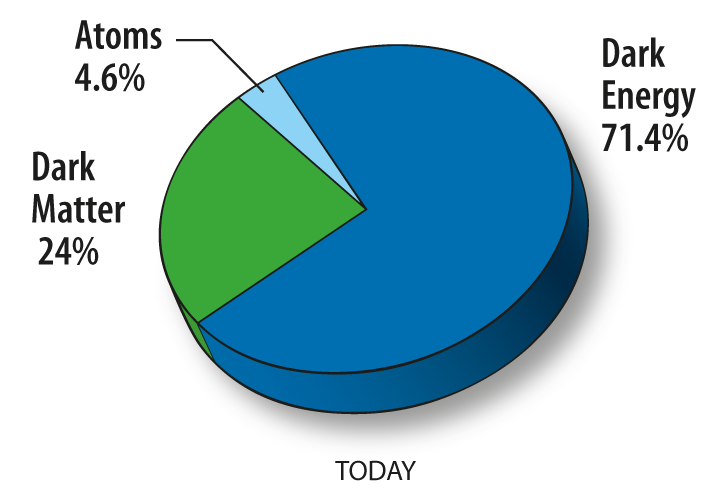
Ordinary form of matter, like table, chair, your computer, you, the stars, the planets, etc. is an absolute minority in what comprises this vast universe. The universe is said to be composed majorly of some mysterious matter and energy, rightly called the dark matter and dark energy. 

Source: http://wmap.gsfc.nasa.gov/media/121236/121236_NewPieCharts720.png

A brief introduction: Scientists observed that galaxies move with way more speed than that should be possible due to their present mass. Thus, they concluded that there must be some "missing mass" which they are not able to see or detect, but it has its gravitational influence! They called this "missing mass" dark matter. On the other hand, earlier scientists believed that the universe must be contracting due to the gravitational attractions of massive bodies. But, the Hubble Telescope provided information that contradicted it. The information (not going into what the information exactly was) proved that the universe was indeed expanding! Now scientists were in a fix! Thus, they concluded, yet again, that there must be some mysterious energy that is repelling bodies and is enabling the universe to expand. With no clue of what it is, they called it dark energy!   


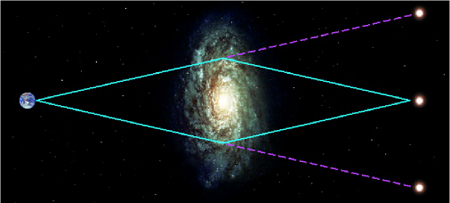
Now, dark matter and dark energy are entirely invisible. They do not interact with any form of known matter, though the gravitational effect of dark matter is felt and "gravitational lensing" is an example of its visible effects. "Gravitational lensing" is nothing but bending of light due to gravitational effect of dark matter. The first picture shows what causes gravitational lensing and the second picture shows its effect. The arcs you see are because of gravitational lensing.Dark matter is attractive in nature and dark energy is repulsive, and that is all that we know about them. One more thing, there are millions of dark matter particles going past us, through us, through the walls, through the earth, every second, and we just don't feel them, again because they do not interact with anything!
Having talked about dark energy and dark matter and having substantial knowledge about them, I could still not figure out what they actually are! And then, an idea struck me. And then, as I developed that idea, and I found a way to tell about the cause of Big Bang while explaining the known properties of dark matter and dark energy at the same time.

Dark Energy and Dark Matter, I think, are multi-dimensional matter, i.e. like we humans are 3 dimensional beings, dark energy and dark matter may be nothing else but matter which is more than 3 dimensional and hence it cannot be perceived easily by us, due to the different kind of energy that it possesses, though its effect can be felt. 

I hypothesize that before the BIG BANG, a particle existed which itself was made of multiple dimensions. Its constituents were dark matter and dark energy, i.e. multi-dimensional form of matter. To simplify, like we humans being 3 dimensional can be considered to be made of 3 dimensional particles, which themselves are made of 2 dimensional particles and which are made of 1 dimensional particles, similarly, that starting particle, which was multi-dimensional, was made of particles of different dimensions which we now know as dark energy and dark matter.  

Source: http://prancer.physics.louisville.edu/
The picture evidently shows how dark energy has evolved at a greater rate than dark matter during the evolution of the universe. Similarly, inside that starting particle, initially, dark matter was in majority and hence it held the starting particle firmly. But, later, as the dark energy began evolving in greater amounts, it started to counter the force by dark matter and tried to expand the particle. At an instant, dark energy had evolved to such great extent that it could have expanded the particle, but the dark matter still held the particle firmly. And hence, there occurred a BANG, where the starting multi-dimensional particle disintegrated into many other particles of simpler but varied dimensions, i.e. 1D, 2D, 3D, 4D, etc. among which 3D constitutes only a small part of the universe. Thus, except us 3D beings, there exist various forms of matter in varying dimensions. Due to their higher dimensions, they cannot be perceived by us but surely exert their share of gravitational force. This itself we call dark matter and dark energy!

Also, remembering the conclusion I had made in my first post: An object experiences a force when its energy interacts with that of the agent. Dark energy and dark matter, being multi-dimensional, have energy which cannot interact with that of light, due to the difference in the cause of their energies. Hence, due to no interaction, no reflection of light takes place when light passes through them, and hence, dark energy and dark matter are invisible, though, bending of light can occur due to the gravitational effect of this form of matter. 

The String Theory talks about how our universe may not be three-dimensional, i.e. how we see it to be, but it indeed may be 10-Dimensional hyperspace, while the M-Theory talks about 11-Dimensional hyperspace. This proposal is a result of the mathematical conclusions derived in the theories. While speculating about our origin and its cause, this theory faintly approves of the idea of multi-dimensional hyperspace. Though the String Theory is yet to be proven, it indeed is extremely intriguing and creative! 

It all fits, doesn't it? But again, this is just a hypothesis based on an idea that struck me and may very well be far from reality! Dark Matter and Dark Energy may not even exist! It is even a possibility that they are composed of a new fundamental particle which is still missing from our Standard Model. What can that be? A special particle, with what properties? We will see in my next post!

Thursday, 12 February 2015

Discovering Our Creator - Does Science support the existence of God?

I ended my last post with a question: There may exist some forms of energy that cannot interact with light and hence are invisible, but they are able to influence us, interact with us and guide us and they are constantly near us, seeing us, and may be even controlling us, but we never get to know! But surprisingly, we do have a name for such kind of energies! What is it?

Let me give you the answer: God! Many of you would think: This is a science blog. Then why are we becoming philosophical? Well, Science does support the existence of God. What matters is how you define God! I define God as the creator of "our" universe, creator of everything we know about, and some things we are yet to discover.

Often people assume scientists to be atheist. While that may occasionally be true, but it is majorly a myth. "http://www.godandscience.org/apologetics/sciencefaith.html" gives you a list of 13 GREAT scientists who believed in God. Give it a thought, all that has happened to make us possible: big bang, formation of Earth as a planet, most suitable distance from the Sun to allow us to survive, a moon to protect us from asteroids, evolution, etc. how can it all just be a coincidence? I fail to believe that there was no driving force behind all this!

Very interesting indeed it is to know how scientists used the fact that God exists, to make scientific breakthroughs. Albert Einstein said that he always wanted to know how God made this Universe. While speculating a theory of his, he would often imagine himself as God and think, "If I was God, would I impart such a feature in my Universe?" And whenever he realised that the concept was too complex and God would never have used such irrational and unsymmetrical concepts, he discarded the concept.

Evidently, the way I define God did give me a way, rather unconventional, to define us, our universe and our existence. How many of you have heard of those virtual reality games? Wikipedia defines virtual reality (VR) as a computer-simulated environment that can simulate presence in real or imaginary worlds. Meaning to say, that you have a virtual identity, a virtual character, and you live in a virtual world with other virtual beings.

You can control your character, make him do things, and watch him constantly. Now, imagine if that character inside the computer somehow gets to know that there is someone outside his world, who is controlling his actions, making him do things and watching him constantly. What do you think the character will call that someone? GOD!

On  considering the above statement, you might have already got my point. God may be a higher dimensional being, and by higher dimensional I mean of greater dimensions than just 3 of them, who made this extremely advanced virtual reality game, called the Universe. He is able to control us, manipulate us, guide us, and constantly watch us, but He cannot physically interact with us, just like we cannot physically interact with a character inside a computer game.

Upon thinking, you will get more analogs and relations. Like a new character is born whenever a new user signs up, similarly, may be a new Universe is born whenever a new higher dimensional being makes His own computer game. This is exactly what Multiverse is, multiple universes existing simultaneously. Then what are Black Holes? Black Hole may very well represent the universes which are dead, or in other words, the higher dimensional beings who signed off or stopped playing.

It may seem too unconventional and insane to even consider this thought, but the concept has some scientific basis. The String Theory has a principle called the Holographic Principle which suggests that the Universe can be seen as a 2-D Hologram.

The virtual world we play in in computer games is itself two dimensional but it appears to be 3 Dimensional, much like what the Holographic Principle tells us about our existence. Hence, the idea may not be entirely gross!

In conclusion, I would like to say that may be we will never be able to know who created us. Our lives are way too short to decipher the mysteries of the entire universe. In this post, I tried to present an idea which can define our existence. But wait, even if God created us in the form of a computer game, how did it all start? How did our universe come into existence? Scientists give an answer: the Big Bang. We all know what happened after the Big Bang, but WHY did the Big Bang happen? We will see in the next post!

P.S. -  I am not trying to hurt any religious sentiments. Like all religious people, I too believe in God              and I am just trying to present an idea that came upon my mind. So, take it easy!

Thursday, 22 January 2015

The SINGLE Cause of ANY Force!

"A pull or a push is called a force"- that is what my class VIII Science book said. Then there was only one force: applied mechanical force, i.e. push or pull. But now, when I am in standard XII, I have encountered many forces: electric force, magnetic force, gravitational force, applied mechanical force, etc. But, even after knowing almost all forces, have you ever given a thought that "WHY" does a force act? WHAT makes a force to act? You will surely know it by the end of this post!

According to Wikipedia, "In physics, a force is any interaction which tends to change the motion of an object." There are four fundamental forces- gravitational force, electromagnetic force, strong nuclear force and weak nuclear force. While all these forces have different characteristics and arise due to different interactions, they all are FORCES after all. And this made me think that since they all are forces, they should have a common cause.

But, the problem now was to find "an" answer. What one thing is common between a massless charge and a chargeless mass? And I did get an answer: ENERGY! A massless charge has its energy just like a chargeless mass does. Just the difference is that a chargeless mass possesses energy by virtue of its mass and the massless charge possesses energy by virtue of its charge. We all are nothing but energy existing in different forms.

 Now, from here, whatever I say is what I am trying to conclude and propose.

I think that there are different kinds of energy or rather different components of energy. Two energies should have something in common to interact with each other. For example, an electron and a proton have energy by virtue of their charge, their mass and their spin. Thus, there is a lot in common in the energies of a proton and an electron and so, they can interact. A ball and I have energy by virtue of our mass. Hence, I can interact with the ball, i.e. throw it, catch it, etc. Or, should I say, that I can APPLY FORCE on the ball! EXACTLY! If energy of one object can interact with energy of another object, then the two objects will exert force on each other.

Thus, I will now answer the question I had written earlier: What is the CAUSE of a force? I think, that the cause of a force exerted by an agent on an object is the interaction of the energy of the agent and that of the object. The energy of a proton and an electron are able to attract due to some inherent similarities and hence, a proton is able to exert a force of an electron and vice-versa. This also validates Newton's Third Law: To every action, there is an equal an opposite reaction. This can be explained by a simple statement: You cannot touch without being touched! To understand this, let us take an example. Consider two objects A and B which have energies that can interact with each other. Now, A's energy is interacting with B's energy.


This region of interaction can be considered as the common region of A and B. Now, in this common region, not only the energy of A interacts with that of B, but also, energy of B interacts with that of A! Hence, B will exert a force on A as well. And this itself, is the Action Reaction Law. Hence, this law should be valid in all circumstances where the energies of two bodies are able to interact with each other. Also, if these two bodies are taken FAR AWAY from each other, their energies will not be able to interact, and hence, they will not exert force of each other. This is exactly what is seen in the case of gravitational forces or coulombic forces.

By this, I also imply that if two objects have energies which have causes which are completely independent of each other, then they CANNOT interact. Thus, if I assume that my energy is completely different than yours, then I cannot interact with you, i.e. I cannot touch you or hit you or push you!


Now, as you can see here, Higgs Boson has mass ONLY, while a gluon and a photon are entirely massless. From the following data (image from Wikipedia) we see that nothing is common between a Higgs Boson and a gluon or a photon. Meaning to say, that the Higgs Boson has mass only and so its energy is only by virtue of its mass, whereas, a photon and a gluon have spin only and hence their energy is only by virtue of their spin.  Hence, according to my concept, since the energy by virtue of mass will be entirely different from the energy by virtue of spin, so, a Higgs Boson should not be able to interact with a gluon and a photon. Thankfully, yes, quoting Fermilab: "The Higgs particle does not interact with massless particles, such as a photon or a gluon. " This might very well prove my theory about the cause of force.

To conclude, what if we make an object whose energy is such that it cannot interact with the energy of light? Then, the light would neither reflect nor refract. Hence, that object will be invisible! What if we make a suit which envelops our energy and prevents it from interacting with Earth's energy? Then, we will not feel Earth's gravity, in other words, we will fly! Thus, there may exist some forms of energy that cannot interact with light and hence are invisible, but they are able to influence us, interact with us and guide us and they are constantly near us, seeing us, and may be even controlling us, but we never get to know! But surprisingly, we do have a name for such kind of energies! What is it? I will tell you in my next post.